China's Tech Surge: AI, Humanoid Robots, and Chips at the Heart of the 15th Five-Year Plan
Picture a country that turns its rival's economic sanctions into rocket fuel for its own tech industry. That's precisely what's happening in China in early 2026. As Washington tightens its semiconductor export restrictions, Beijing responds with an ambitious five-year plan, a booming AI startup ecosystem, and an army of humanoid robots starting to roll onto factory floors worldwide. The world is witnessing a historic inflection point.
 Source: Wikimedia Commons / Pavel Dvorak (CC0)
DeepSeek and AI: The Empire Strikes Back
A year ago, the release of DeepSeek R1 sent shockwaves through Silicon Valley. The Chinese AI model, developed at a fraction of the cost of its American competitors, triggered a 17% single-day plunge in Nvidia's stock. One year on, the Hangzhou-based startup is reportedly preparing to strike again.
DeepSeek V4, a trillion-parameter model, is said to be in its final development stages. Most notably, it was reportedly built to run exclusively on Chinese chips — with Nvidia and AMD deliberately excluded from early testing. This is as much a symbolic statement as it is a strategic move.
Beyond DeepSeek, China's AI ecosystem is firing on all cylinders. According to the Global AI Enterprise Technology Innovation Index 2026, published in early April, 51 of the world's top 100 AI benchmark companies are now Chinese. The government's "AI Plus" initiative — aimed at integrating artificial intelligence across every sector of the economy — is being enshrined in official policy documents for the first time. The scale of ambition is staggering: China is targeting an AI-related industry worth 10 trillion yuan (approximately $1.45 trillion) by 2030.
The "One Person Company": A New Entrepreneurial Model
AI is also reshaping how business itself works in China. A new phenomenon is making waves: the "One Person Company" — a single-person venture powered by AI tools. Entrepreneurs like Zheng Haifeng, who founded a digital culture company in Qingdao after the 2026 Spring Festival, are using AI to handle tasks — design, content creation, marketing, accounting — that once required entire teams. This model could redefine entrepreneurship in the age of automation.
The Humanoid Robot Revolution
If AI is the brain of China's tech revolution, robots are its hands. And here too, China is making a powerful statement.
 Source: Xinhua / Huang Zongzhi
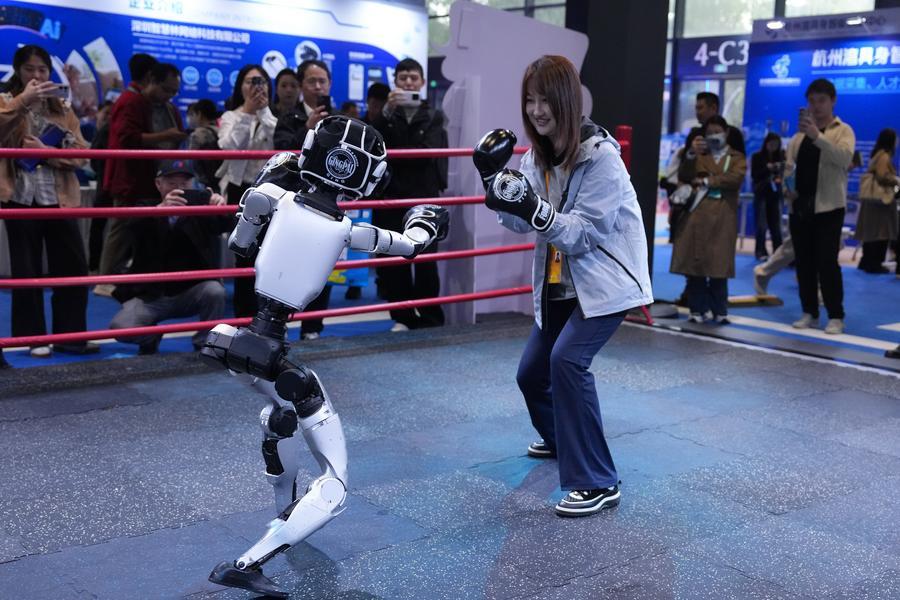
As of early 2026, China boasts over 140 humanoid robot manufacturers producing more than 330 distinct models. Companies like Unitree Robotics, AgiBot Innovation, Beijing Galbot, and EngineAI earned praise at CES 2026 from Gary Shapiro, CEO of the U.S. Consumer Technology Association, who highlighted their "real progress in advanced mobility and the ability to perform multiple tasks effectively."
The irony hasn't been lost on observers: many of the humanoid robots now appearing in American factories are built with Chinese components and technologies — a fact laid bare in a Wall Street Journal investigation titled "Under the Skin of America's Humanoid Robots: Chinese Technology."
From Showcase to Shop Floor
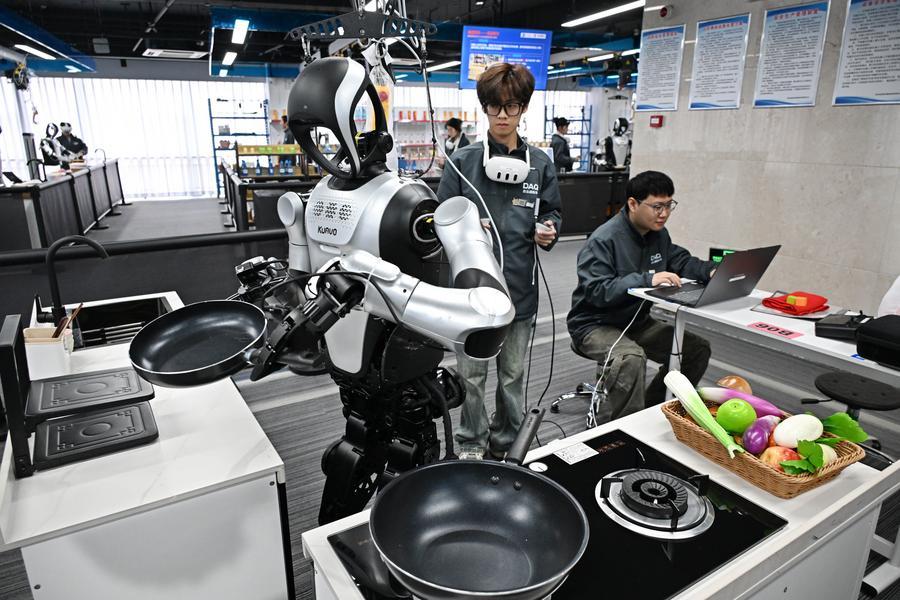
The line that captures the moment: "If 2025 was the year humanoid robots learned to walk, 2026 is the year they're being put to work." Applications are proliferating: home assistance, logistics, manufacturing, precision surgery. The Chinese government is piloting programs to deploy robots in sectors suffering from labor shortages — a particularly pressing issue in a country grappling with a rapidly aging population.
 Source: Xinhua / Li Ziheng
Semiconductors: The Self-Sufficiency Drive Is Paying Off
Perhaps the most striking dimension of China's tech rise is the resilience of its semiconductor industry in the face of U.S. sanctions.
SMIC (Semiconductor Manufacturing International Corporation), China's largest chipmaker, reported revenue of $9.3 billion for 2025, up 16% year-on-year — a record high. Analysts expect the figure to surpass $11 billion in 2026. Hua Hong, another Chinese chipmaker, reported a record fourth quarter with $659.9 million in revenue. Meanwhile, Moore Threads, Nvidia's Chinese rival, is forecast to post 2025 revenue growth of between 231% and 247% year-on-year.
Memory chips are booming too. CXMT (ChangXin Memory Technologies) saw revenues soar 130% to over 55 billion yuan (approximately $8 billion). While its HBM (High Bandwidth Memory) chips lag behind those from Samsung, SK Hynix, and Micron, in a market where foreign HBM is subject to export restrictions, CXMT has become the indispensable domestic alternative.
The Sanction Paradox
Analysts are converging on a counterintuitive conclusion: U.S. restrictions have had the opposite effect in several key segments. "U.S. export controls have added rocket fuel to chip demand, amplifying growth from areas like electric vehicles and AI data centers," says Paul Triolo of Albright Stonebridge Group. By cutting China off from its traditional suppliers, Washington has inadvertently accelerated the formation of a robust domestic supply chain.
The 15th Five-Year Plan: The Long Game
All of this would be fragile without a long-term strategic vision. In March 2026, China adopted its 15th Five-Year Plan (2026-2030), outlining the country's economic priorities for the next five years.
Technology ambitions sit front and center. AI is mentioned more than 50 times in the document. "Extraordinary measures" are earmarked for semiconductors. Robotics, quantum computing, brain-computer interfaces, and even flying cars are among the targeted domains. The plan also envisions leveraging China's rare earth advantages as a strategic bargaining chip.
In response, the United States is moving to tighten the screws. A congressional bill targeting advanced chip-making equipment sales to China was introduced on April 3rd, 2026. But the question increasingly being asked is: are these restrictions arriving too late?
Conclusion: A Competition That's Reshaping the World
The temptation is to read the Sino-American tech rivalry as a zero-sum game — where one side's gains are the other's losses. But reality is more nuanced. Experts are increasingly talking about a "complementary competition": while the U.S. leads in cutting-edge innovation and chip design, China excels in scalability, supply chains, and large-scale deployment.
The technological gap between the two powers, once measured in years, has reportedly narrowed to mere months in some areas — AI in particular. The question is no longer whether China will become a tech superpower, but how the rest of the world — Europe especially — will position itself in this emerging bipolar landscape.
What to watch next? The release of DeepSeek V4, and the first large-scale production lines for Chinese humanoid robots. Both could arrive before the end of 2026.